Hashimoto's and Viral Load: Is a Virus Driving It? | Holistic Healing
Do You Have a Virus, or Do You Have Control? What's Really Driving Your Hashimoto's?
Fatigue that doesn't lift no matter how much you sleep. Brain fog that makes you re-read the same sentence three times. Hair thinning at the part line. Cold hands and feet even in the middle of summer.
If you have Hashimoto's, you've probably felt at least one of these. And at some point, you've probably asked yourself: "do I have a virus"
That's not the right question.
The Real Question: Do You Have Control Over Your Viral Load?
Here's the question that actually matters: do you have control over the viral load you already picked up when you were young?
Because it's not just Epstein-Barr. The vast majority of infections we're exposed to in childhood and early adulthood stay with us for life. That's simply how viruses work, especially the ones in the herpes family. And to clear up a common misconception, not all herpes family viruses are sexually transmitted. Epstein-Barr is one of them, and most people picked it up through ordinary childhood exposure, not anything else.
So the real question isn't whether you have a viral load. Every single person does. The question is whether you have control over it.
How does a virus actually reach thyroid tissue?
This is the part conventional medicine rarely explains, and it's where things get interesting.
Many herpes family viruses, including Epstein-Barr, don't fully clear after the initial infection. Instead they go dormant, or latent, inside certain cells and can reactivate later in life, often during periods of high stress, illness, or immune suppression. When immune function is strong, that reactivation gets shut back down quickly. When it isn't, the virus has more room to persist and spread into tissue it wouldn't normally reach, including the thyroid.
Once a virus is present in or near thyroid tissue, researchers describe a couple of proposed mechanisms for how that can contribute to autoimmunity:
Molecular Mimicry - some viral proteins closely resemble proteins found in your own thyroid tissue. When your immune system builds an army to fight the virus, that army can end up mistakenly recognizing thyroid tissue as a threat too, because it looks similar enough to what it was trained to attack.
Bystander Activation - when a virus sets up shop inside thyroid follicular cells, the immune response mounted against it can cause collateral damage to the surrounding tissue simply by being present and active in that location, whether or not mimicry is involved.
Neither of these requires the virus to be new or newly acquired. Most people have been carrying these viruses since childhood or their teenage years. What changes is whether the immune system has enough capacity to keep them dormant, or whether stress, nutrient depletion, gut dysfunction, or other burdens have worn that capacity down enough to let the virus become active again.
That's the piece that gets missed when the question stays stuck at "do I have a virus." Almost everyone does. What matters is what condition your immune system is in to manage it.
The Viruses Linked to Hashimoto’s
Here's what separates people who carry a viral load without issue from people who don't.
Immune competent people carry viruses inside a wide range of tissues and cells for their entire lives without real problems. Not because they lack a viral load, but because their immune system is functioning well enough to keep it in check.
Immunocompromised people, meaning their immune system is struggling, dysfunctional, or imbalanced, struggle with that exact same viral load. We're all exposed to the same things. We all pick up the same viruses and organisms. The difference is what your immune system is able to do with them.
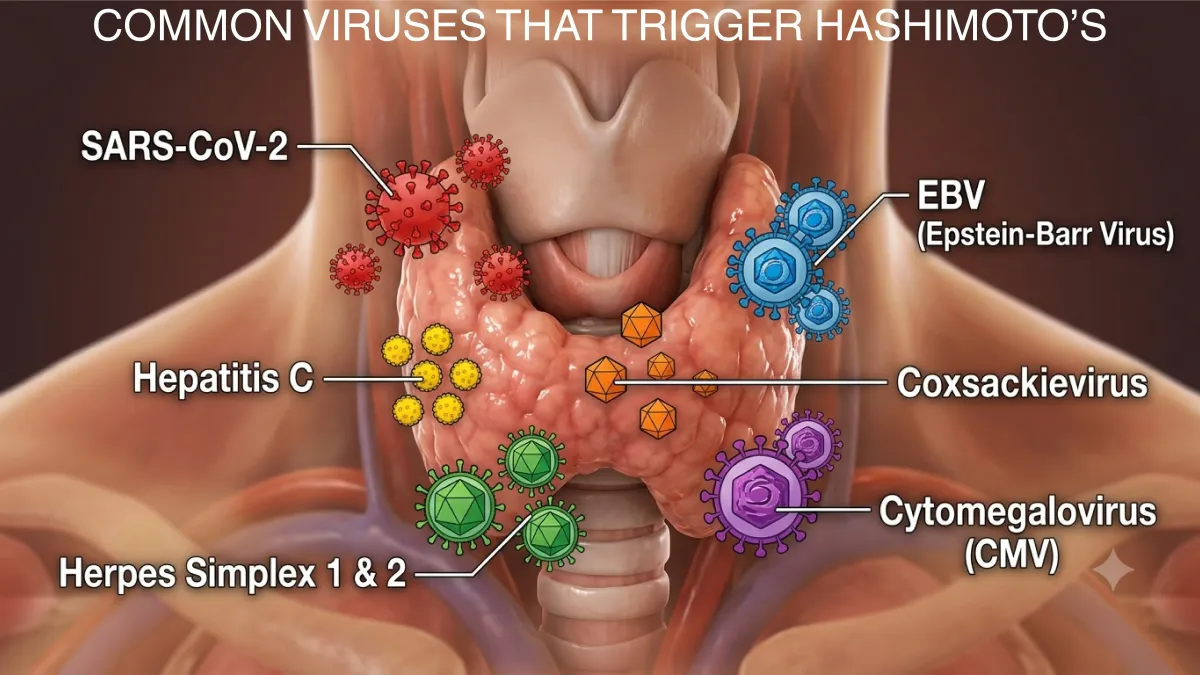
If you have Hashimoto's, there are many viruses that can be part of your picture, but these specific viruses have a tendency to affect thyroid tissue more than others:
Coxsackievirus
Epstein-Barr virus (EBV)
Herpes simplex 1 and 2 (HSV)
Hepatitis C
SARS-CoV-2
Cytomegalovirus (CMV)
Up to 53% of people with Hashimoto's may have a virus hiding inside the very cells that make thyroid hormone, called follicular cells. This can be associated with triggering Hashimoto's in the first place, or with perpetuating the autoimmune process if something else was the original trigger.
What Else Could Be Driving Your Hashimoto's
Viral load is one piece of the puzzle, but it’s rarely the only piece. In my practice, I regularly see Hashimoto’s cases where the full picture also includes:
Environmental exposures, especially mold. This was my own story, and it changed the course of my family's health too. If you want the full picture of what happened to me, my husband, and my children, I share it here. Mold and other environmental toxins can place a significant burden on immune function, which leaves less capacity available to keep a dormant viral load in check.
Gastrointestinal dysfunction. Candida overgrowth, H. pylori, and parasites like Blastocystis hominis are things I catch often on functional stool testing in Hashimoto's cases. Since a large share of immune activity originates in the gut, unresolved infections here can keep the immune system distracted and depleted.
Lyme disease and co-infections. Tick-borne infections often show up in the same clinical picture as Hashimoto's and can add significant burden to an already taxed immune system.
Nutrient deficiencies. Thyroid hormone production and immune regulation both depend on specific nutrients. When those run low, the body has fewer resources to manage both processes at once.
HPA axis dysfunction. Chronic stress and dysregulated cortisol patterns affect immune signaling throughout the body, including the signaling that keeps latent viruses dormant.
This is exactly why "do I have a virus" is the wrong question on its own. If you only chase the virus and ignore the gut infection, the mold exposure, or the nutrient depletion sitting underneath it, you can address one trigger and still feel stuck, because the others are still active.
Conventional labs rarely screen for all of these at once, which is why so many people with Hashimoto's are told their labs are "normal" while they're still struggling with symptoms every day. A standard thyroid panel checks TSH, and sometimes T4, but rarely looks at viral markers, gut infections, nutrient status, or cortisol patterns, even though all four can directly affect how your thyroid autoimmunity behaves.
Want to Know Exactly What Labs to Ask For?
Understanding that viral load, gut health, nutrients, and HPA axis function all play into Hashimoto's is one thing. Knowing exactly which labs to request is another. My free guide, Thyroid Labs: A Holistic Perspective, breaks down the full thyroid panel, the optimal functional reference ranges most doctors don't check for, and what to ask for beyond a basic TSH.
Grab the free Thyroid Labs guide here.
Frequently Asked Questions
Can Epstein-Barr virus cause Hashimoto's?
Epstein-Barr is one of several viruses researchers have found more often in thyroid tissue of people with Hashimoto's, and it's associated with both triggering and perpetuating the condition in some cases. It's rarely the only factor at play.
Is Hashimoto's caused by a virus, or is it genetic?
Most likely, both play a role alongside other triggers. Genetics can set the susceptibility, while viral load, environmental exposures, gut health, nutrient status, and stress physiology can determine whether that susceptibility turns into active autoimmune disease.
How do I know if a virus is affecting my thyroid?
Standard bloodwork won't tell you. Comprehensive functional testing that looks at viral markers alongside gut health, nutrient status, and HPA axis function gives a much fuller picture than TSH alone.
Your Next Step
Real wellness isn't the same thing as managing a disease, and it isn't a biohacking shortcut either. It requires finding your unique root cause disrupters, building metabolic resilience, and moving step by step through a real journey, one that focuses on the right things at the right time rather than chasing every protocol at once.
You don't need to guess which of these is driving your Hashimoto's. Comprehensive functional labs can look at your viral load, gut infections, nutrient status, and HPA axis function together, so you're working from the full picture instead of one piece of it.
If you're ready to find out what's actually driving your symptoms, book a Results and Review consultation and let's map it out together: Toxic Load Reveal Panel
Love, Paulina
Functional Diagnostic Nutrition® Practitioner
A mom on a mission. Healthier families. Stronger generations.


